Posts

Preliminary Findings - Introducing the Hiss Hass Hoos Boys

Image
Identifying a target group to work with this year, more than other years was quite tricky. Because I don't have my own classroom this year, I have the lucky opportunity to work with students across our whole school and therefore am able to pick and identify students from Y0-Y8. This year, my target group identified are a group of 5 Pasifika Year 7/8 Boys who are all learning below/well below their expected year group in all Reading, Writing and Maths.  The collection of data (assessments, student voice, teacher observations, my own observations) lead me to find the following trends:  Punctuality - Ready for learning These boys were in no rush to get to school. They were often late (3-4 a week), sometimes rolling up to school after 9:30am. 'Slept in' was the most common reason for coming late.This made me wonder 'why there was no sense of urgency to get to school', 'what is happening in class/school for them that isn't motivating them to come' followed by...

Data collection - what? how? why?

Image
To in form my inquiry, I will be using the follow tools, measures, and approaches: Tools -  • A google form to collect student voice on learning and key ideas for Term 1 and looking forward, for Term 2. Student voice is essential in gaining an insight to how they are feeling about what they are learning. Student agency is important and is a big driver in 'what' is being taught/explored so it allows an opportunity for me to provide a space for my learners to be engaged in their learning and see relevance in it, therefore making connections.    • Collect  student voice  and  self assessment  through interlead (teacher practice and a structured set of questions). This self asssessment is important because my goal is to ensure that how I am teaching, my practice, is effective for my learners. My expectation is that my teaching practice will change and adapt to the needs of my learners - my students don't adapt to my needs. The importance of student voice,...

Manaiakalani Teacher Only Day

 Wow. Just wow! My tinana and wairua are overflowing after listening to and sharing at our Manaiakalani Teacher Only Day.  Our keynote speaker, Dr Rae Si'ilata and Kyla Hansell spoke about the importance of students' identity and culture in our classrooms and teaching practice. It was such an amazing keynote that I didn't even take notes - I was too inspired to jot down anything.  My key takeaways from them:  • Continue to use students frames of references to inform the way in which we approach students learning and their needs.  • Continue to use culture and identity in my teaching • Continue to provide spaces and opportunities for our tamaiti to lead, learn, share their expertise.  • The importance of understanding bilingualism and the brain  • Continue to find and expose students to texts that are 'windows and mirrors' and provide a balance in my setting.  • Continue to build awareness ... My biggest learning from today came from our very own ...

Workshop Prep

Image
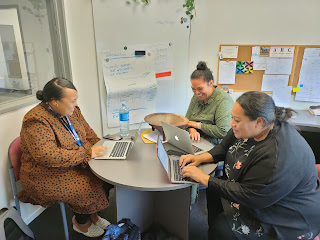
 With our Manaiakalani Cluster Teacher only Day coming up soon, a lot of our teachers are preparing to share and run workshops.  I was very fortunate at the most recent CoL PLG to 'speed date' with Dorothy Apelu (Tamaki College) and Christine Tupou (fellow colleague here at GTS). Our talanoa left us with wanting more. We walked away from that PLG eager to reconnect and run a workshop at the up coming Manaiakalani Teacher Only Day.  Each talanoa session that we've had to date have been overwhelmingly reassuring but also filled with frustration at what our tamaiti, our tamariki are having to deal with in our classrooms.  Our workshop session, we are planning to include STUDENT VOICE , and this I'm excited about. Our tamaiti have such powerful voices yet in different settings do not see themselves and their peers as valueable and knowledgeable beings. It is proven that student voice is important, is powerful and should be evident in our classroom and teaching practice, ...

What the hub?

Image
Reading Time!  This was an easy read. A good read. Like, a really really good read.  Culturally Responsive Pedagogies/Overview - What is Culturally Responsive teaching?  - The Education Hub  We, as teachers need to move beyond cultural blindness to cultural responsiveness. But what does it look like, you ask? Well, let me share with you my takeaways.... • Culturally Responsive Teaching is -  validating  the diverse knowledge and practices of our students. -  comprehensive  as it incorporates preferred ways of knowing and the cultural and life experiences of students as well as the history and culture of the group. -  empowering  and transformative  as it transforms the way students see themselves in terms of their personal efficacy. It is transformative and emancipatory in that it reveals that multiple versions of 'truth' are valid and no single version is total and permanent. • Culturally responsive pedagogies can reduce the g...

What's the challenge? What's my challenge?

Image
Every document that is available and related to Pasifika and Maori learning is focused on Teacher Practice. This is the heart of the matter. Until teachers change their attitudes and practice student learning will stagnate. My focus is on teacher practice looking at Cultural Responsiveness.  Do teachers know their students' cultures? Where they were born? Language spoken at home? Who they live with?  What their students’ home responsibilities are? Is there evidence of each child’s culture in the classrooms? Beyond that - do teachers know their students’ stories? And what to do with that gold? Without this crucial information and a change in attitudes and practice, our tamariki will struggle to make connections, stay connected and be confident, all of which are outcomes of student learning.  Bishop et al (2014) expresses that new cultures or ethnicities require teachers to engage quickly and positively with learners from any culture and background so that their learners ca...

Thinking about the year - what's the go?

Image
It's only March and we've already experienced 2 lockdowns. What a way to welcome in the year of 2021! But e ven with the 2 lockdowns, the ball is rolling here at GTS. Our Manaiakalani Cluster Data that was shared with us for 2020 painted a clear picture of our successes for the year and where the need lies for our school. In lockdown 4.0, GTS CoL teachers and Management met via google meets to bring to life our ideas and possible inquiry focus for 2021. This korero gave me much confidence in what my focus would be for this year and ideas for how I can support my teachers in our school and throughout our cluster could possibly look like.  In the past my inquiries have developed throughout the years, focusing first on student outcomes and then later, further developing a deeper look as to what I am doing in my class, what and how my planning looks like, and how it looks like in my class with my learners. This shift in my thinking to take a deeper look into my practice is what has...