Posts

Evaluation / the ENTIRE Bursts and Bubbles presentation!

Image
  Target Group: B.R, L.T, K.H, M.A, S.T The catalytic aspect of student learning my inquiry focused on this year was "What changes can I make in my practice to ensure that my learners deepen their understandings of key concepts and ideas in writing?"   I identified this as my focus when I noticed the attitudes and behaviour of my students towards their learning in writing wasn’t making traction in their achievement in this learning area. Although cluster wide data shed a light on Reading, my learners in my class this year needed a big booster in the learning of writing.  To build a rich picture of my students’ learning I used: • Student Voice - through a google form. I used the Literacy Learner Profile that I had used in previous years as an ALL teacher to collect information about interests, attitudes, struggles and things they enjoy about writing. • Writing samples - EOY 2019 and BOY 2020 easttle writing, unpacking any patterns, gaps and strengths in their writing as we...
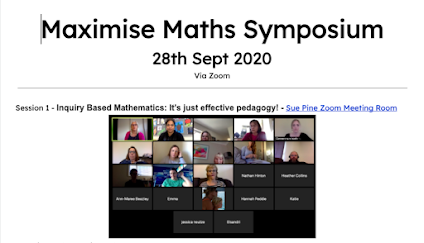

PLD - Maths Symposium

Image
Click on image to Personal Notes from PLD  Provider/Presenter: Workshop 1 - Sue Pine  Inquiry Based Mathematics: It’s just effective pedagogy! Workshop 2 - Lucie Cheeseman  Mathematical Discovery - exploring visual mathematics and the art of “Make and Create” If I was to summarise the key things I took away from this Professional Development what would they be and why? The need to think about the DATs in my teaching of maths and how I can use this to further support the learning of my students. By being deliberate I am maximising this window of learning for my students. The need to 'make and create' for mathematical learning, that it's not just about Using Materials to support their learning of concepts. Students should be given opportunities to make choices of which materials and also to physically or digitally make and create a visual representation of mathematical concepts. The importance and need for low floor, high ceiling type of number problems, problems that encou...

PLD: Boys in Literacy - Cracking the code with Marshall Diggs

Image
  Click on image to open up Personal Notes from PLD Name of Course/Programme/Seminar: Boys in Literacy - Cracking the code Provider/Presenter: Marshall Diggs If I was to summarise the key things I took away from this Professional Development what would they be and why? You can have  control  or you can have  growth  - but you can’t have both. Position myself to fit the needs of my boys. Make myself uncomfortable so they don’t have to be. Greatest contribution is not what you teach, but who you teach Boys will not invest into learning until I invest into them Clear is kind. Unclear is unkind Boys like competition but not when it exposes their inabilities Light fires not fill buckets It’s not what you teach but who you teach Interest based - not curriculum based Repeat, restate - but don’t rephrase How has this professional development challenged my thinking? Didn't really challenge, rather affirm what I'm doing with my boys. - Experiences to build language for wr...

Keeping my students engaged during our google meets.

Image
Keeping my students engaged during our google meets!  A simple recipe with ingredients that we have around the house. Choc-bix slice. This was integrated with LCS (Learn, Create, Share) and Writing. Thinking ahead and when we head back into school, this links perfectly with our fractions that we've been learning about -EXCITING! I didn't want anyone to miss out so we spent time planning and preparing for it, figuring out what we had at home and what we needed. I didn't want parents stressing out, so with gloves on and a face mask strapped behind my ears, I headed out to deliver the goods. This is another authentic learning experience, planned for, prepared for and SO MUCH FUN! Check out these smiles! This gives my learners another experience to write about. Some whanau were involved and it was great to see them become more and more independent.

Blogpost #10 - Ways of monitoring the effects? How will I keep a record?

Identify informal & formal ways I am monitoring the effects of my changed practices on learner outcomes. Explain the reflections and tweaks I am making along the way.  Describe how I will keep a record of each of the above in a manageable way The best way, I feel for me to monitor the effects of my changed practice at this point in time is to do so on a weekly or a bi-weekly basis. Each week, my writers are writing more and more and by choosing a sample from their weekly work, analysing it will give me an idea of their gaps and what I need to focus on for the following week. This will be done for the select students (my star writers) that fit in the groups identified from the end of year data for writing last year. 'Interleading' is a great way to monitor and reflect my own teaching and practice. The use of relevant templates and critical thinking allows me to really dig deep and think about further changes or tweaks I can make in my teaching practice. Collection of s...

Blogpost #8 - Inquiry Question and theory of action/chain of events

Inquiry question and theory of action/chain of events  My inquiry for this year is 'What changes can I make in my practice to ensure that my learners deepen their understandings of key concepts and ideas in Writing?' Unpacking this has allowed me the time to think critically about what my students are able to do and also their gaps. Over the course of this year and the ever changing changes in the world, my inquiry has taken a slight change in its focus, however, still relevant to Writing. The focus this time round is around integrated planning and how planning rich authentic learning experiences can encourage students to produce rich pieces of writing.

Blogpost #9 - How will I collect information?

Describe how I will collect information about the implementation of my changed practice/intervention How will I collect information? -  Student voice , through google forms or interlead. See  T3 Student Voice Post  as an example. This will help me get an idea of where my students at and how they feel about writing. Do they see themselves as a writer? This will also give me ideas on the topics of writing, future lessons e.g. teaching them editing skills, word building, and also what I need to stop or cut back on doing. -  Student writing and analysis  of this. The use of LPF Writing and our school matrices to help make a judgement of what they can do independently. We are currently exploring the Writing LPF as a staff and refining our teaching practice along the way. We are focusing on one signpost at a time so this will allow for in depth reflection and refining of teaching practice. -  Student blogs - and the quality of their writing in the post. ...